



Sciatica describes pain and nerve symptoms caused by irritation or compression along the sciatic nerve pathway. The pattern often starts in the lower back or buttock and travels down one leg, sometimes with tingling, numbness or weakness. Pain limited only to the back is less typical. The diagnosis, neurological findings and warning signs matter more than the label alone.
Is this sciatica consultation right for me?
This consultation is designed for people whose back-to-leg pain keeps returning, affects sitting, walking or sleep, or needs a clearer pattern review alongside current care.
What makes sciatica different from ordinary back pain?
Sciatica is a symptom pattern, not simply another name for low-back pain. Irritation or pressure around a lumbar nerve root can produce pain that travels through the buttock and down the back or outer side of one leg. Tingling, numbness or weakness can occur along the same route.
A slipped or herniated disc is one possible cause. Spinal narrowing, spondylolisthesis and other conditions can also produce sciatic symptoms. Buttock, hip, sacroiliac-joint and peripheral-nerve problems can mimic parts of the pattern, so the travel route and examination findings matter.
A scan is not automatically required at the first visit when there are no warning signs. NICE advises against routine imaging in non-specialist care and recommends imaging in a specialist setting when the result is likely to change management. Existing films and reports should still be brought to consultation.
The Sciatica Pain Route Map
Instead of recording only “7 out of 10 pain,” Dr. Akshata marks the exact route. The endpoint and neurological symptoms can change the next step.
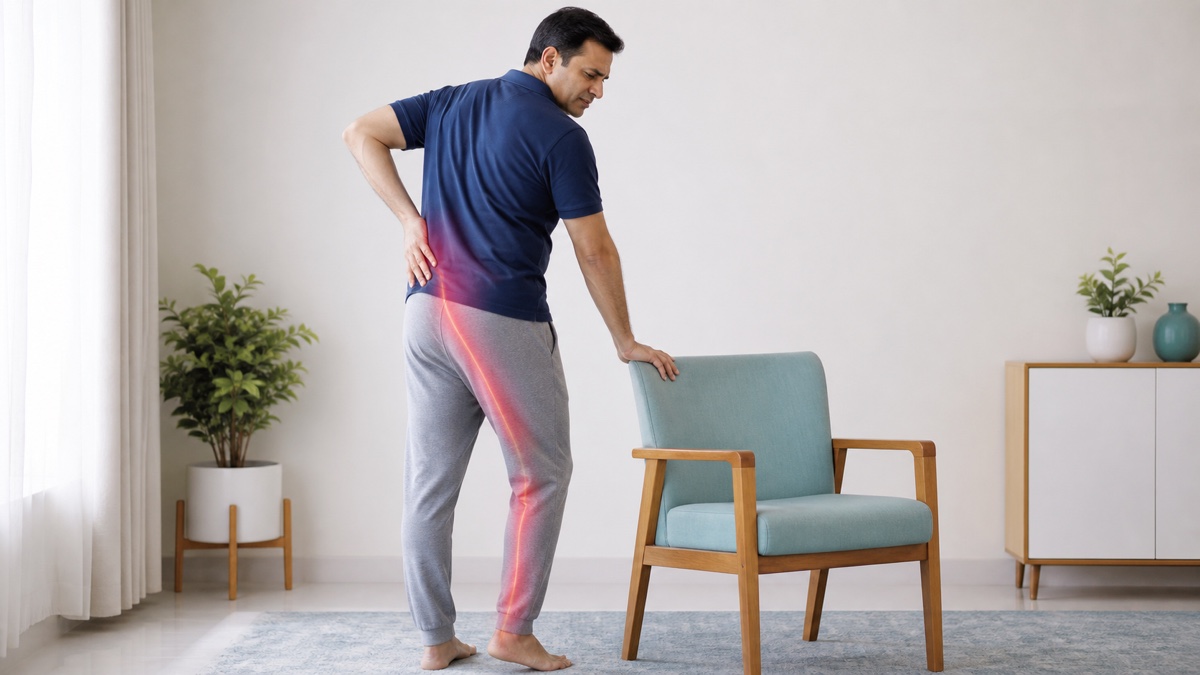
Sciatica commonly follows a one-sided back-to-leg route
The image illustrates a typical route, but real cases vary. During consultation, the route is compared with numbness, muscle control, walking, sitting tolerance and any available report.
Common Symptoms of Sciatica
- ✓Sharp, electric, burning or shooting pain down one leg
- ✓Pain beginning in the lower back or buttock and reaching the calf, foot or toes
- ✓Pins and needles, altered sensation or numb patches
- ✓Pain made worse by sitting, bending, coughing or sneezing
- ✓Leg heaviness, reduced push-off or difficulty lifting the foot
- ✓Difficulty rising from a chair, climbing stairs or putting on socks
- ✓Sleep disturbed while turning in bed or lying in one position
- ✓Symptoms that return after travel, lifting, long sitting or reduced activity
The 24-Hour Trigger Map
A single clinic snapshot can miss the pattern. Dr. Akshata compares six ordinary moments across the day.
What can cause sciatica?
Sciatica can arise when a nerve root is irritated or compressed. The cause cannot be decided from a website checklist alone.
- 01 Disc-related irritation: A bulging or herniated disc may irritate a lumbar nerve root and produce radiating leg symptoms.
- 02 Spinal stenosis: Narrowing around the nerves may produce pain, heaviness or numbness, often linked with standing or walking.
- 03 Spondylolisthesis: One vertebra slipping relative to another can narrow the space available to a nerve.
- 04 Injury or structural change: Trauma, fracture and less common spinal conditions require condition-specific assessment.
- 05 Look-alike patterns: Hip, buttock, sacroiliac-joint or peripheral-nerve problems may resemble parts of sciatica.
- 06 Daily load: Long sitting, abrupt lifting, poor sleep and reduced conditioning may influence an episode, but they do not prove its underlying cause.
Dr. Akshata's Clinical Perspective
Tap each clinical note to see how I think through this case in consultation.
01 The pattern I commonly see
In my clinic, people often arrive saying they have “back pain,” but their most useful clue is that the pain crosses the buttock and travels below the knee. Many have tried changing chairs, applying heat or taking intermittent pain medicine without recording what makes the pain travel farther down the leg.
02 What I look for in case-taking
I ask the patient to trace the route with one finger. I note the endpoint, sensation, numb areas, cough or sneeze aggravation, sitting tolerance, walking distance, sleep position, foot control and any change in bladder or bowel function. I review the examination and MRI report when available rather than interpreting a scan line in isolation.
03 Why function is recorded
Two patients may both report 7 out of 10 pain but have different safety and follow-up needs. I compare chair rise, putting on socks, a ten-minute walk, stairs and turning in bed. A repeatable task gives a clearer follow-up marker than a pain number that changes with mood, timing and activity.
04 A common mistake before consultation
A common mistake is prolonged bed rest or repeatedly stretching into sharp travelling pain without checking the neurological pattern. Another is focusing only on the MRI words while ignoring new weakness. I advise urgent assessment for bladder or bowel change, saddle numbness, severe symptoms on both sides or rapidly worsening weakness. Every case is different. I recommend a proper consultation before starting any treatment.
How sciatica change is measured without relying on pain score alone
The diary uses the same six markers each day. It can be shared with Dr. Akshata and with a physiotherapist, orthopaedic clinician or spine specialist when care is coordinated.
Pain Endpoint
Buttock, thigh, knee, calf, foot or toes
Intensity
Morning, longest sitting period and night score
Sensation
Tingling, numb area and whether it is spreading
Strength
Heel walk, toe walk or foot control as clinically advised
Function Ladder
Socks, chair rise, ten-minute walk, stairs and bed turning
Medicine + Activity
Pain medicine, rest, exercise and physiotherapy noted
Pune Areas We Serve Sciatica consultation from nearby areas Open local area links
Sciatica consultation from nearby areas
Sciatica consultations are available at the Lohegaon clinic for patients from nearby Pune areas and online across India.
Sciatica Care Map at Dr. Akshata's Clinic
The consultation connects the route, neurological safety, current treatment and repeatable function markers.
When to Seek Medical Attention
- Sciatica on both sides, or severe numbness or weakness in both legs
- Numbness around the genitals, anus or inner-thigh saddle area
- Difficulty starting urination, inability to urinate, or new loss of bladder control
- Loss of bowel awareness or new inability to control bowel movements
- Rapidly worsening leg or foot weakness, foot drop, major trauma, fever or unexplained weight loss
Keep prescribed medicines, urgent care and specialist follow-up unchanged unless the treating clinician advises otherwise.
Same pain score, different sciatica decisions
A pain number cannot show the route, neurological change or function loss. These examples explain why the next step differs.
| Situation | Conventional / specialist care | Homeopathy at Dr. Akshata's clinic | Decision point |
|---|---|---|---|
| 7/10 buttock pain without numbness or weakness | Clinical assessment, activity advice and symptom management | Map the trigger pattern and individual symptoms after safety screening | Record route and function before follow-up |
| 7/10 pain reaching the foot with numbness | Neurological examination and review based on duration and severity | Document exact sensory area and coordinate current care | Monitor whether numbness spreads or function changes |
| 7/10 pain with new foot weakness | Prompt medical assessment; imaging or referral may be required | Do not delay neurological or spine assessment | Strength change takes priority over the pain score |
| Pain with bladder change or saddle numbness | Emergency hospital assessment | No routine consultation first | Seek emergency care now |
| Persistent pain despite a coordinated plan | Reassess diagnosis, rehabilitation and specialist options | Re-take the pattern rather than changing remedies repeatedly | Review whether the diagnosis or care plan needs to change |
How Dr. Akshata Structures the Consultation for Sciatica
Dr. Akshata structures remedy selection only after the sciatica pattern and safety needs are clear. The route, sensation, position, time pattern, temperature response, sleep and general health are considered together.
Pain Quality
Electric, burning, pulling, cramping or bruised sensations are separated.
Direction
Downward, upward, shifting or fixed routes are documented.
Position
Sitting, standing, bending, walking and lying responses are compared.
Relief Pattern
Heat, cold, pressure, movement and rest responses are recorded.
What to Expect During Treatment
The first visit records the pain route, neurological symptoms, daily-function losses, current medicines, physiotherapy plan and previous episodes. Reports are reviewed when available.
Follow-up compares the same function ladder and seven-day diary. Prescribed medicines, physiotherapy and specialist appointments are kept visible in one coordinated plan.
Common Homeopathic Remedies for Sciatica
These are traditional educational examples from homeopathic literature, not a list for choosing a sciatica medicine or potency. Similar pain routes can require different prescriptions after a complete consultation.
Please do not self-prescribe. Remedy selection requires detailed individual case analysis by a qualified homeopath.
Need a clear plan for recurring sciatica pain?
Book an in-clinic or online consultation with Dr. Akshata. Keep your reports, medicine list and a short seven-day symptom note ready.
What Patients Say About Dr. Akshata
Google reviews from patients who visited for homeopathy care at Dr. Akshata's Homeopathy.
Diet & Lifestyle Guidance for Sciatica
Sciatica care is usually more about safe movement, pacing, sleep and rehabilitation than a special “nerve diet.” Advice should match the diagnosis and current level of pain.
✓ Helpful Habits
- Continue normal activity within tolerable limits when medically appropriate
- Change position before prolonged sitting triggers the full pain route
- Follow physiotherapy exercises prescribed for your diagnosis
- Use the seven-day diary to compare walking, sitting and sleep
- Keep current medicines and appointments documented
✗ Habits to Reduce
- Do not stay in bed for long periods without medical advice
- Do not force stretches that send sharp pain farther down the leg
- Do not stop prescribed pain or nerve medicines suddenly
- Do not treat new weakness as an ordinary pain flare
- Do not use an MRI report as a self-diagnosis without clinical correlation
"I ask every sciatica patient to show me the pain route before describing its intensity. Where the pain ends, whether sensation or strength has changed, and which daily task has been lost often tell me more than one pain score. I keep those markers visible at every follow-up."
Trusted Sources Used for This Guide
This page uses reputable medical references for symptoms, diagnosis, safety notes, and patient education.
Common Patient Questions Sciatica Patient Questions About Care Open quick consultation answers
Sciatica Patient Questions About Care
These answers address the decisions patients usually need before booking, not shuffled versions of the same keyword.
How can I tell sciatica from ordinary lower-back pain?
Sciatica commonly travels from the lower back or buttock down one leg and may include tingling, numbness or weakness. Back pain without a leg route is less typical, although examination is needed for diagnosis.
Does every sciatica patient need an MRI?
No. NICE advises against routine imaging in non-specialist care when serious pathology is not suspected. Imaging is considered when it is likely to change management, or when neurological change, trauma or other warning signs make it necessary.
Why does sitting make my sciatica worse?
Sitting can change spinal and soft-tissue loading, but the meaning depends on the route, duration and diagnosis. Record how many minutes you can sit and whether standing makes the pain retreat or travel farther.
Is numbness more important than the pain score?
Numbness does not automatically mean an emergency, but spreading numbness, new weakness, foot drop, symptoms on both sides, saddle numbness or bladder or bowel change requires prompt assessment.
Can sciatica be reviewed in an online consultation?
History, pain-route mapping, report review and follow-up tracking can begin online. New weakness, major neurological findings or warning signs require an appropriate in-person or urgent assessment.