



Alopecia areata usually causes sudden, smooth, round or oval patches without scaling or scarring. An alopecia areata consultation with Dr. Akshata starts by confirming that the pattern is not fungal, traction-related, diffuse or scarring hair loss, then records the patch map, reports, current treatment and individual symptom pattern for coordinated follow-up.
Is this alopecia areata consultation right for me?
This page is for people with smooth patchy hair loss who want a diagnosis-aware, measured consultation rather than another generic hair-fall plan.
What is Alopecia Areata?
Alopecia areata develops when the immune system attacks hair follicles. It most often appears as one or more smooth, round or oval areas of hair loss. The skin usually has no scar, marked redness or heavy scale, although short broken or “exclamation-mark” hairs may appear at an active edge.
The scalp is common, but beard, eyebrows, eyelashes and other body hair can be affected. Some people develop tiny nail pits or rough, brittle nails. Patchy alopecia areata is the most common form; loss of nearly all scalp hair is called alopecia totalis, and much wider body-hair loss is called alopecia universalis.
The course is unpredictable. Hair may regrow, new patches may appear, or episodes may recur. A dermatologist can often diagnose the condition by examining the patches and nails, sometimes using dermoscopy. Blood tests or a biopsy are considered when another diagnosis or associated condition needs evaluation.
The Alopecia Areata Pattern Map
Location and surface clues help separate alopecia areata from other causes of patchy or diffuse hair loss.
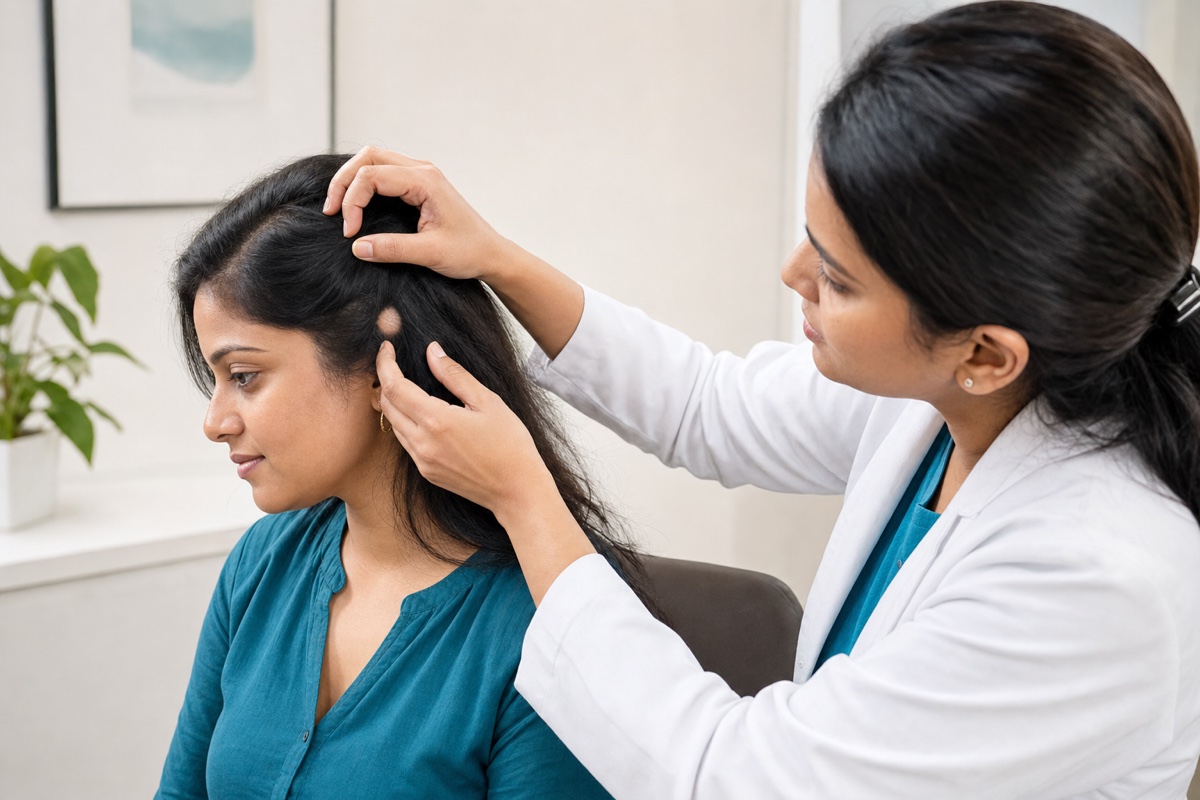
A smooth patch needs the correct diagnosis
Dr. Akshata records the scalp surface, patch border, broken hairs, size, location and date. Scaling, pain, pus, marked redness or loss of follicle openings can point away from ordinary alopecia areata and change the referral plan.
Common Symptoms of Alopecia Areata
- ✓One or more sudden smooth round or oval scalp patches
- ✓Patchy beard, eyebrow, eyelash or body-hair loss
- ✓Short broken or exclamation-mark hairs near a patch edge
- ✓New patches appearing while an earlier patch changes
- ✓Tingling, mild itching or burning before hair loss in some people
- ✓Tiny nail pits, rough nails, brittleness or crumbling
- ✓More extensive scalp loss in alopecia totalis
- ✓Widespread scalp and body-hair loss in alopecia universalis
Clues That Change the Diagnosis or Plan
Not every bald patch is alopecia areata. These details determine whether tests or specialist care are needed.
What Causes Alopecia Areata?
Alopecia areata is an autoimmune condition. Genes influence susceptibility, but the timing and course can differ greatly between people.
- 01 Autoimmune activity: The immune system targets hair follicles and interrupts normal hair growth.
- 02 Genetic susceptibility: Family history can increase risk, although many patients have no affected relative.
- 03 Associated autoimmune conditions: Thyroid disease and vitiligo are more common in people with alopecia areata.
- 04 Atopic tendency: Eczema, hay fever or other allergic conditions can occur alongside alopecia areata.
- 05 Illness or emotional stress: These may precede an episode in some susceptible people, but many cases have no obvious trigger.
- 06 Age and extent: The condition can begin at any age; younger onset, extensive loss and nail changes may influence prognosis and monitoring.
Dr. Akshata's Clinical Perspective
Tap each clinical note to see how I think through this case in consultation.
01 The pattern I commonly see
In my clinic, I commonly see patients after a relative or hairdresser suddenly notices a coin-shaped patch. Many have already changed oil, shampoo or supplements, while the exact date, early photograph and rate of spread were never recorded. Some arrive calling every type of hair loss “alopecia,” so I first separate a smooth focal patch from diffuse post-illness shedding, patterned thinning, fungal scalp disease, traction, hair pulling and scarring loss. That distinction matters more than the product used on the scalp.
02 What I look for during case-taking
I ask when the first patch appeared, whether more patches followed, and whether the scalp felt normal, itchy, painful, scaly or tender. I inspect the surface and border, brows, lashes, beard where relevant and the nails. I review dermatology findings, dermoscopy, prescriptions and any thyroid, iron or vitamin reports already advised. I also ask about vitiligo, eczema, autoimmune illness, family history, recent fever, major stress, sleep and nutrition without assuming that stress alone caused the condition.
03 How I track the consultation
I create a patch map and use consented, standardised photographs taken in similar light, angle and hair position. At follow-up I compare patch diameter, number, border activity, new short hairs, eyebrow or beard involvement, nail changes and any new areas. I also record dermatologist treatment and timing, because a change should not automatically be attributed to one part of a combined plan.
04 Common mistakes and referral decisions
The common mistake I see is waiting for several patches to appear while repeatedly changing oils, or stopping dermatologist treatment as soon as fine hair appears. I recommend dermatology review for a new uncertain patch, rapid spread, eyebrow or eyelash loss, extensive disease or treatment decisions. Pain, pus, heavy scale, scarring, loss of follicle openings or a child with broken scaly hairs needs prompt assessment for another cause. Every case is different. I recommend a proper consultation before starting any treatment.
How patchy hair-loss progress is recorded
The same patch locations and visual markers are compared over time so change is documented without relying on memory.
Standard Photos
Same light, angle, parting and distance at each review
Patch Size
Diameter or mapped area measured consistently
Patch Count
New, stable, joining or recovering areas recorded
Hair Signs
Fine regrowth, colour, density and edge activity
Nails + Other Sites
Nails, brows, lashes and beard checked where relevant
Treatment Timeline
Dermatology and consultation changes dated separately
Pune Areas We Serve Alopecia Areata consultation from nearby areas Open local area links
Alopecia Areata consultation from nearby areas
Dr. Akshata consults at her Lohegaon clinic, accessible from Dhanori, Kharadi, Wagholi, Viman Nagar, Vishrantwadi and Yerwada. Online consultation is also available across India.
Alopecia Areata Care Map at Dr. Akshata's Homeopathy
The Alopecia Areata plan starts with diagnosis and safety checks. Follow-up then compares One or more sudden smooth round or oval scalp patches and Patchy beard, eyebrow, eyelash or body-hair loss at agreed intervals.
When to Seek Medical Attention
- Rapidly increasing number or size of hair-loss patches
- Loss of most scalp hair, eyebrows or eyelashes
- Pain, pus, marked redness, swelling or fever
- Heavy scale, black dots or broken hairs, especially in a child
- Shiny scarred skin or loss of visible follicle openings
- A new patch with weight change, marked fatigue or other systemic symptoms
Keep prescribed medicines, urgent care and specialist follow-up unchanged unless the treating clinician advises otherwise.
Dermatology care and Dr. Akshata’s consultation
The first job is to confirm the type of hair loss. Dermatology care establishes the diagnosis and medical options; Dr. Akshata’s consultation organises the individual history, current plan and measurable follow-up.
| Situation | Conventional / specialist care | Homeopathy at Dr. Akshata's clinic | Decision point |
|---|---|---|---|
| New smooth patch | Scalp and nail examination, dermoscopy and diagnosis | Detailed timeline, patch map, photographs and relevant health history | Confirm alopecia areata first |
| One or a few limited patches | Observation or treatments such as topical or injected corticosteroids may be discussed | Coordinate current care and track patch, hair and symptom changes | Choose care by age, extent and preference |
| Rapid or extensive loss | Dermatologist-led systemic options and closer monitoring | Do not delay specialist assessment; document wellbeing and treatment timeline | Dermatology leads medical treatment |
| Scale, pain or scarring | Tests for fungal, inflammatory or scarring hair loss | Identify the mismatch and arrange prompt referral | Treat the correct diagnosis |
| Emotional distress | Practical camouflage, support and mental-health care when needed | Discuss sleep, confidence, stress and coping as part of the consultation | Address scalp and wellbeing together |
How Dr. Akshata Structures the Consultation for Alopecia Areata
Dr. Akshata plans the consultation around the confirmed diagnosis, patch pattern, scalp and nail signs, reports, current dermatology treatment, autoimmune history, stress, sleep, nutrition and the patient’s priorities.
Diagnosis-aware Review
The patch is differentiated from fungal, diffuse, traction and scarring loss.
Individual Pattern
Timeline, associated symptoms, triggers, reports and current care are organised.
Measured Follow-up
Photos, patch size, new areas, hair signs, nails and treatment timing are compared.
What to Expect During Treatment
The first consultation reviews every patch, scalp surface, speed of change, brows, lashes, beard and nails where relevant, medical and family history, reports and all current treatments.
Follow-up focuses on stable measurements. Alopecia areata can regrow, recur or spread unpredictably, so the plan is revised if new areas appear or the diagnosis no longer fits.
Common Homeopathic Remedies for Alopecia Areata
These are historical examples from homeopathic literature, not a self-prescription or guaranteed regrowth list. Selection depends on the complete case and does not replace diagnostic or dermatology care.
Please do not self-prescribe. Remedy selection requires detailed individual case analysis by a qualified homeopath.
Book an alopecia areata consultation
Bring dated scalp photographs, dermatologist or dermoscopy notes, prescriptions, relevant reports and a timeline showing when each patch appeared.
What Patients Say About Dr. Akshata
Google reviews from patients who visited for homeopathy care at Dr. Akshata's Homeopathy.
Diet & Lifestyle Guidance for Alopecia Areata
No single food reverses alopecia areata. Nutrition advice is based on the patient’s diet, symptoms and confirmed deficiencies rather than routine high-dose supplements.
✓ Helpful Habits
- Eat adequate protein through regular balanced meals
- Bring iron, thyroid, vitamin D or B12 reports if already tested
- Protect exposed scalp from strong sun
- Use gentle hair and scalp care
- Keep a dated patch-photo record
✗ Habits to Reduce
- Start multiple high-dose supplements without testing
- Rub onion, irritants or harsh chemicals on a patch
- Stop prescribed dermatology treatment abruptly
- Share combs when fungal infection is possible
- Delay care for rapid spread, scarring, pain or infection
"With alopecia areata, I document the exact patch rather than using “hair fall” as the only measure. A dated photograph, patch size, scalp surface, nail findings and treatment timeline make follow-up far more useful."
Trusted Sources Used for This Guide
This page uses reputable medical references for symptoms, diagnosis, safety notes, and patient education.
Common Patient Questions Alopecia Areata Patient Questions About Care Open quick consultation answers
Alopecia Areata Patient Questions About Care
Short answers to distinct questions about smooth scalp patches, diagnosis, reports, online consultations and clinic appointments.
Is a smooth round bald patch always alopecia areata?
No. Alopecia areata is common, but fungal infection, hair pulling, traction and scarring disorders can also cause patches. The scalp surface, broken hairs and dermoscopy help distinguish them.
Why should I photograph each patch?
Hair and lighting make memory unreliable. Standardised dated photographs help compare patch size, new areas, border activity and regrowth signs over time.
Can alopecia areata affect the beard, brows or nails?
Yes. Beard, eyebrows and eyelashes may be involved, and some people develop nail pits, roughness or brittleness.
Can I consult online for alopecia areata?
Yes, when clear photographs, the patch timeline, prescriptions and reports are shared. An uncertain, scaly, painful, infected or rapidly spreading patch may need in-person examination.
Where is the alopecia areata consultation clinic in Pune?
Dr. Akshata consults at the Lohegaon clinic, accessible from Dhanori, Viman Nagar, Kharadi, Wagholi, Vishrantwadi and Yerwada, with online appointments also available.